Give the page a memory
Repeated margins, a numbering system or a reliable caption style make a sequence easier to understand. The reader learns where to find the small information and can spend more attention on what changes.
This kind of consistency is useful precisely because it does not need to become the subject of every page. It works as a quiet memory carried from one composition to the next.
Make the departure specific
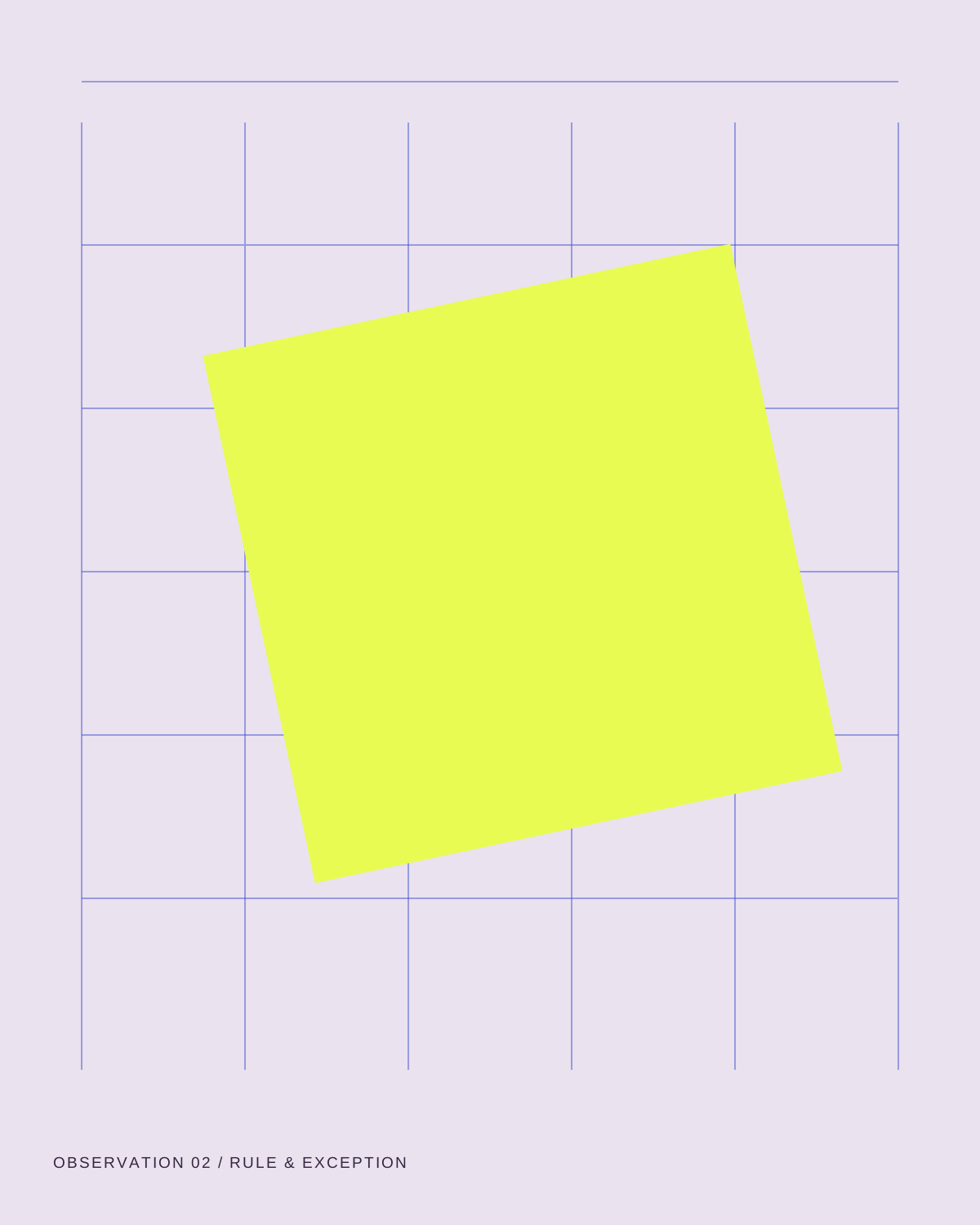
An exception has more force when it changes one relationship at a time. A larger image, a title crossing a column or a fragment pushed to the edge can create a new emphasis without dismantling the whole structure.
If every part breaks the rule, there is no exception left to notice. The composition becomes a collection of unrelated gestures.
Keep something steady
When testing a departure, keep an anchor: the caption position, the scale of the small type or a repeated interval. The steady part gives the change something to act against.
A useful system is not one that prevents variation. It is one that helps explain why a particular variation belongs.